Make your guess first
- The helmet is on its hook at home.
- The market is two minutes away.
- There is a police officer at the crossing.
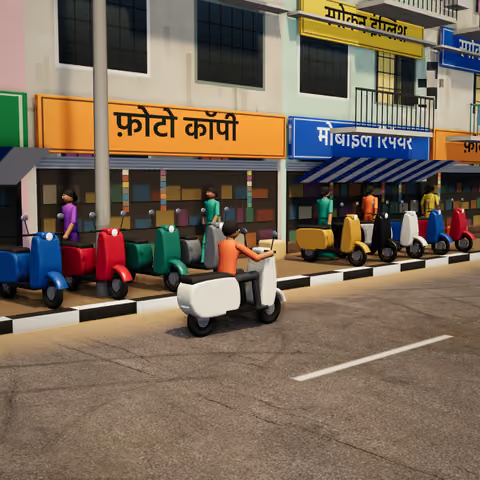
What does riding without a helmet cost? Picture it: the market is two minutes away, the helmet is hanging on its hook at home, and there is a police officer at the crossing. Hold on to your guess, and ask yourself one more thing: does it end with the money?
At a glance
- ₹1,000
- the penalty under s. 194D
- Aged over four
- the helmet rule covers a pillion too (s. 129)
Central law · checked 4 Nov 2026 · the amount in your state may differ
On this page
The price of two minutes without a helmet
- The money: section 194D of the Motor Vehicles Act sets a penalty of ₹1,000 (India, the central Act; checked 4 Nov 2026). That is the central figure, and the amount in your state may differ. Penalty is the Act’s word for what most people call the fine.
- The licence: section 194D also disqualifies the person who has to pay the penalty from holding a licence for three months. Paying is not the whole bill.
- The licence, taken: under s. 206(4), if an officer has reason to believe a driver has committed an offence under s. 194D, the officer must seize the licence and send it to the licensing authority for proceedings to disqualify the driver or revoke (cancel) the licence. What happens there is set by s. 19 of the Act, which this page has not checked.
- The head: the World Health Organization (WHO) says in its helmet manual (2023) that in a standard helmet it is the expanded polystyrene (thermocol-like) lining inside the outer shell that absorbs and spreads the energy of an impact to the head. Without a helmet, nothing like that lining sits between your head and the impact. “Standard helmet” is the manual’s own term; it does not refer to the Standard Mark of the Bureau of Indian Standards (BIS).
The rule in plain words
Section 129 of the Motor Vehicles Act covers every person above four years of age who is driving, riding or being carried on a motor cycle. It applies in a public place: any road, street, way or other place the public have a right of access to. The Act calls a motor cycle a two-wheeled motor vehicle, so we read a scooter as one too. For a driver carrying a child between nine months and four years on the back, rule 138(7) of the Central Motor Vehicles Rules sets separate duties, given in the questions below.
On the helmet itself, the Act asks for three things:
- It conforms to the standards the Central Government prescribes.
- Its shape, material and construction could reasonably be expected to give some protection from injury.
- It is securely fastened to the head by its straps or other fastenings.
Separately, the 2020 helmet quality control order, in force since 1 Jun 2021, says helmets for riders of two-wheelers must meet the latest version of IS 4151 and carry the Standard Mark under a BIS licence for that mark (a licence for the mark, not a driving licence).
The central Act names one exception: a Sikh wearing a turban while driving or riding in a public place. A state may have its own exemptions; we have not read those rules.
Section 129 has no distance exception and no speed exception.
What people say, and what the Act says
People say“The one behind doesn’t need a helmet.”
The rule saysSection 129 includes a person “being carried”, so the rule covers a pillion above four. The s. 194D penalty falls on whoever drives the motor cycle in breach of s. 129, or causes or allows someone else to drive it that way. The Act does not say in so many words whether you, the one driving, are penalised when you wear a helmet and only your pillion does not. Either way, s. 129 covers your pillion too, so they need a helmet of their own. We found no Indian study comparing the risk of the two seats.
People say“I’m only going to the corner.”
The rule saysSection 129 has no distance exception and no speed exception. A lane the public have a right of access to is a public place, just as a highway is. We found no crash or injury rates by trip length.
People say“Any helmet will do.”
The rule saysNot by the Act’s words: it asks for a helmet meeting prescribed standards, whose shape, material and construction could reasonably be expected to give some protection from injury. Separately, the order asks for the Standard Mark. WHO’s manual describes “novelty helmets”, which have no expanded polystyrene lining inside the outer shell and are often made of thin plastic.
The fine, with its state and date
| Whose figure | Amount | In force | Checked |
|---|---|---|---|
| Central lawMotor Vehicles Act, 1988, s. 194D | ₹1,000 |
- No state amount for s. 194D is in our checked records, so the table shows only the central amount.
- Under s. 210A, a state specifies a multiplier, from one to ten, applied to each fine or penalty, so a state’s amount can be up to ten times the central one. We have not checked any state’s multiplier, so the amount in your state may differ.
One question, worked through
Question: The helmet is on your head, the strap hangs open, and you are riding down the lane in your neighbourhood to buy vegetables. Under the Act, does that count as wearing a helmet?
- a) Yes. It is on the head, and that is enough.
- b) No. The Act’s meaning of a helmet includes being securely fastened.
- c) It only matters on a highway, not in a lane.
Pick one, then see the answer.
See the answer
Answer: b. The Act asks for all three things above, and each must be met. An open strap does not meet the last one: being securely fastened to the head. A lane the public have a right of access to is a public place too, so c does not hold either. Driving in breach of s. 129 brings the s. 194D penalty in the table above, and the three months’ disqualification with it. WHO’s manual adds that a helmet not strapped, or not strapped tightly, could come off in a collision.
Helmet myths
Take it further in the app
In the app, this topic opens with a puzzle, and its lessons then explain it step by step.
Questions people ask
What is the fine for not wearing a helmet?
Section 194D of the Motor Vehicles Act sets a penalty of ₹1,000 (India, the central Act; checked 4 Nov 2026), and the person who has to pay it is also disqualified from holding a licence for three months. Under s. 210A a state sets a multiplier from one to ten, so the amount in your state can be up to ten times the central amount.
My pillion has no helmet. Is that against the rule too?
Yes. Section 129 covers a pillion above four as well. The s. 194D penalty falls on whoever drives the motor cycle in breach of s. 129, or causes or allows someone else to drive it that way. The Act does not say in so many words whether you, the one driving, are penalised when you wear a helmet and only your pillion does not. Either way, s. 129 covers your pillion too, so they need a helmet of their own.
Is anyone exempt?
The central Act names one exception: a Sikh wearing a turban while driving or riding in a public place. We have not read the states' own rules.
What is the rule for a small child on the back?
Rule 138(7) of the Central Motor Vehicles Rules, which applies from one year after the February 2022 notification (G.S.R. 126(E)) was published, puts three duties on the driver carrying a child between nine months and four years as a pillion: a safety harness attaching the child to the driver; the child's own crash helmet that fits, or a bicycle helmet meeting a standard the rule names; and a speed of not more than 40 kmph (India, Central Motor Vehicles Rules; checked 4 Nov 2026). Above four, s. 129 covers the child like anyone else. The rule does not say what applies to a child below nine months. The World Health Organization's helmet manual says there is no evidence for the concern that helmets could cause neck injury in children.
The facts on this page come from Sambhalo’s published topics, which an automated review checked before they were published. No lawyer or government office has checked them. This is general information, not legal advice.
By the sambhalo team
Someone is waiting for you at home. Sambhalo.